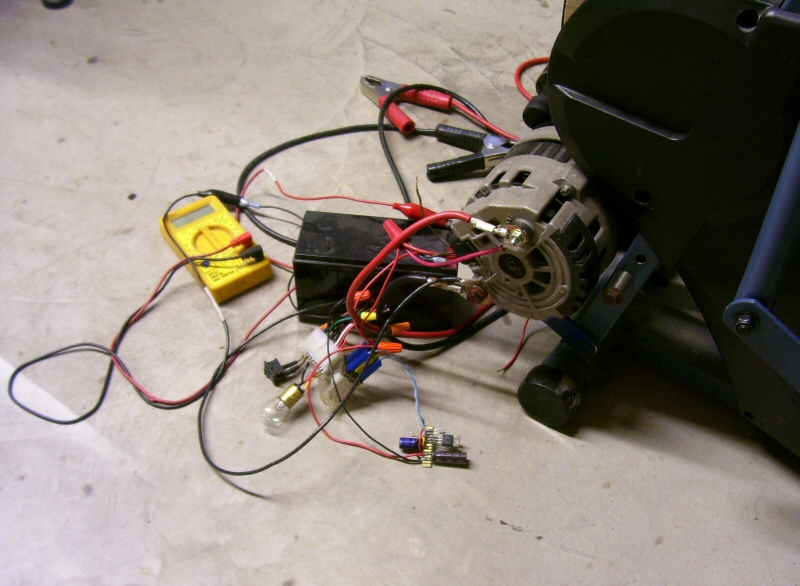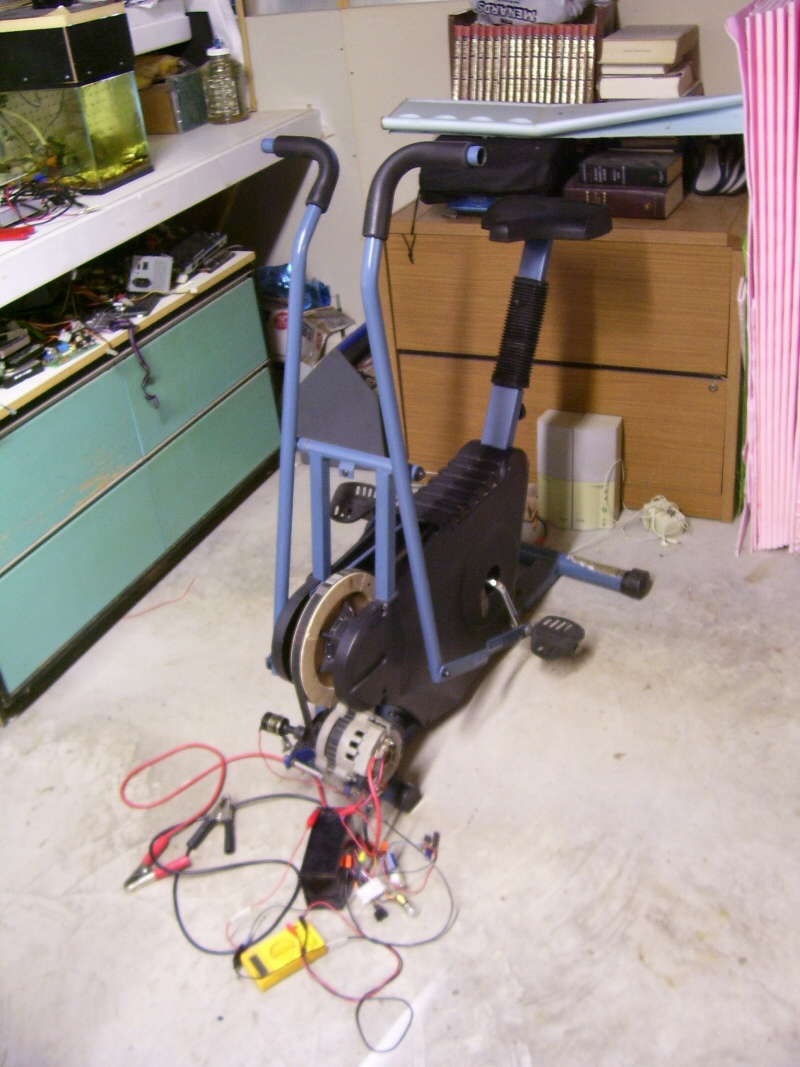
Exercise bike, driving an auto alternator
Airdyne™. It didn’t have nearly enough resistance to suit me, I could
pedal it really fast and not get much of a workout. This exercise bike
sat in my attic for a number of years, and then one day I got an
idea…
Part of the idea was also a result of scrapping out a vehicle that was
no longer worth keeping. Many parts of my old 1994 Chevy Cavalier
were in perfect shape, having less than 100k miles, so I kept the
alternator, radio and a few other things. Now I thought hmm…how
could I hook up this alternator to the exercise bike, and make a little
more resistance than the original air paddles. So here’s the story of
my exercise bike generator.The mechanicals were the easiest part. The exercise bike has a gear
ratio of 8.5:1 between the pedals and the wheel. I already had a short
serpentine belt just the right size (picked up off the highway when
cycling), so the only thing left was to put the right ratio between the
exercise bike wheel and the alternator pulley. The pulley is 2.75
inches, and the length of the found belt was just right to allow a 9.75
inch wheel. This put roughly a 3.5:1 ratio between the wheel and the
alternator pulley.
Making the new wheel was fun. The original air paddles had to be sawn
off (I did this with my band saw) to leave a usable hub for the
mounting the new wheel. Then a wooden wheel was constructed of 5
layers of lauan plywood (actually birch with lauan veneer). Fitting
the rough sawn wheel to the original plastic hub was a cinch, just
tracing out the spokes and then more cutting, on the scroll saw. I
could have made it real permanent and epoxied everything together, but
I just drilled holes and fastened it with screws. It fit really tight
over the leftover plastic spokes, and I used a lot of screws so it
mounted very solidly.
Then to true the new wooden pulley wheel, I simply mounted it with
original bearings and all, over my router table, and slowly turned the
wheel with the router cutting into it. I had to be careful with feed
direction and router bit direction to keep from splintering the
plywood. One pass to do the rough cut, another pass to sligthly recess
the belt groove (which is just a wide flat spot).
The alternator bolted very neatly to the frame posts of the exercise
bike. I didn’t have to put much effort into making the belt extremely
tight, and with the wooden pulley wheel being so true, the tigthening
slots in the two braces are quite short. The plywood pulley really
grabs a hold of the rubber serpentine belt, even without much tension.
I have to believe it’s fairly efficient.
Now for the electrical, there were a few more challenges. You’ve
probably been wondering what the bottle dynamo is doing there on the
left, ready to be engaged with the backside of the serpentine belt.
The trouble is getting the alternator to generate power, without first
getting a 12v boost from a battery. It turns out that it’s not a
simple matter at all to trick an auto alternator into charging.
Part of my troubles with the electrical was the notion that an exercise
bike power generator should be 100% automatic, that is, you get on and
pedal, and electricity is generated. Stop and get off, no power. And
no need for external power, and no drawing of any external power when
not pedaling. But the fact of the matter is, when you turn the key in
your car from “Lock” to “Run”, you’re connecting the alternator’s field
to the battery, and it is indeed drawing power. A tiny bit. Of
course, as soon as you hit “Start” and your engine is running, then the
power is going from the alternator back into the battery. The car’s
battery is serving as an “excitation” battery for the alternator for a
short instance before the engine whips it up to it’s “self-excitation”
speed.
I really tried hard to avoid having an excitation battery. The bottle
dynamo was an attempt in this regard, and I tried many things that
didn’t work. I hooked up the dynamo with some special circuitry so it
would charge up a big electrolytic capacitor, and then trip a relay to
jolt the alternator to charge, and it was all no good. If you’ve
succeeded at this, then I’d like to know, but for now I have given up
and moved on to keeping a small SLA battery from a computer UPS for
excitation, and then once spun up to a few hundred rpms, the alternator
begins to charge.
For now I have a 28 watt “1157” 12v auto taillamp for resistance. It
still isn’t enough resistance to suit me, but I could just connect
another one or two. Or I could even make some practical use of the
electricity, such as charging my laptop or running a radio or
something. It could be a real “hobo generator” to use on camping
trips. (Who wants to take along a stupid exercise bike on a camping
trip?) But it makes for interesting concepts in emergency power
generating, for things like cell-phone charging or computer battery
charging. Some day I want to try a 12v compact flourescent (CFL) bulb
on it.