|
Build your own melting furnace! Melt and pour aluminum! Due to an overwhelming response to my improved foundry furnace, I have made available DETAILED PLANS that you can purchase and instantly download for a small fee.
You
get 52 pages of instructions, CAD drawings, photos, time-saving parts
checklist, suppliers list, step-by-step construction notes, and all the
FAQ's, in printer-friendly pdf format!
|
Detailed plans now available
|
|
|
What we have here are fake corn cobs, made of plastic. They are sliced
exactly in half down their parting line, and then nailed to a piece of
melamine shelving. A chemical called PVA (poly vinyl alcohol) has been
brushed on to act as a mold release for the fiberglass resin.
The whole idea here is to make a pattern for an aluminum corn-cob
making mold. The finished aluminum piece that this pattern will produce
will be used for casting epoxy replicas of...you guessed it, corn cobs.
It's a "mold to make a mold" project! |
Plastic corn halves coated with release
|
|
|
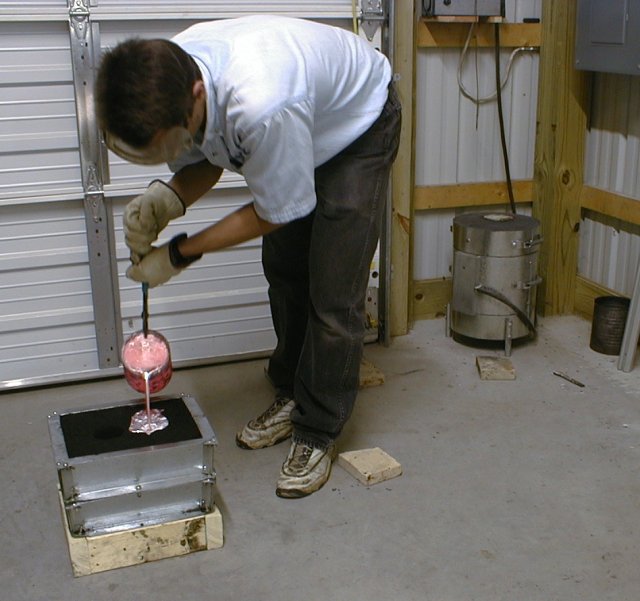
Here we are pouring a sand casting for the Gingery Lathe I am working
on. It is the head stock casting, note the 2x4 box built to extend the
drag portion of the mold. The crucible was quite full, and when
beginning the pour, the metal was a little difficult to aim squarely at
the mold's pouring cup (note the metal splash).
Click the picture and PLEASE NOTE! The person in this picture is CRAZY! (Oh, wait a minute...that's me!) DISCLAIMER: I assume no responsibility for damages caused by the use or misuse of the information on this web page or site!
Another thing I noted was that the metal was just a touch on the warm side, so the casting had some minor sand inclusions. |
Pouring a sand casting
|
|
|
| These are some Gingery Lathe parts that were just shaken out of the
molds. They are still in the rough, as you can see, and the sprues and
risers need to be cut off. The shiny surface is the result of carefully
selecting the right pouring temperature. |
Look at those castings gleam!
|
|
|
|